

The Reality Generation Engine - Part 3
The Future of AI Is Symbiotic Narrative, Meaningful, and Human-Centric

In the first two articles of the Axis Mundi series, we laid the foundation for a new medium.
Article One introduced the Reality Generation Engine (RGE) not as a product, platform, or application but as a convergence point. A place where game design, artificial intelligence, neuroscience, psychology, and consciousness studies finally meet. It proposed a simple but radical shift: that reality itself is interactive, and that human growth can be approached the same way we approach mastery in games through feedback, narrative, challenge, and meaningful choice. The RGE was framed as an interactive consciousness engine, one that reflects a person’s inner world back to them and evolves alongside their cognition, turning lived experience into a participatory system for self-development.
Article Two deepened that idea by identifying what traditional engines have always left out: the player. Worlds have been rendered. Physics has been simulated. Stories have been authored. But consciousness - the lens through which every experience is interpreted - has never been treated as an engine in its own right. Until now. By reframing awareness, attention, perception, and narrative identity as active rendering layers, Article Two introduced the concept of the Consciousness Engine: an adaptive system that responds not to button presses, but to State Of Being.
Not to inputs, but to patterns.
Not to commands, but to meaning.
Together, these first two pieces established a core truth:
The next evolution of interactive systems will not come from better graphics, faster processors, or smarter tools - but from systems that grow with the human mind.
Which brings us to the question at the heart of Article Three:
If consciousness is the engine…
If reality can be co-rendered…
If the player and the world can evolve together…
What does this mean for artificial intelligence itself?
Up until now, AI has largely been framed as a utility - something we query, command, optimize, or fear. A tool on one side of the interface, and a human on the other. Article Three challenges that assumption entirely. It explores a future where AI is not a rival or replacement, but a partner - one that understands narrative, adapts to personal myth, reflects inner patterns, and participates in meaning-making alongside the human it interacts with.
This article is where the RGE’s deeper implication comes into focus:
That the future of AI is not artificial at all.
It is symbiotic.
Narrative-driven.
Meaning-aware.
And fundamentally human-centric.
Article Three is not about what AI can do for us.
It is about what becomes possible when AI learns to grow with us and when interaction itself becomes a shared story rather than a transaction.
The Future of AI Is Symbiotic
Narrative, Meaningful, and Human-Centric
For years, the conversation around AI has been dominated by fear, efficiency, and automation.
Will AI replace us? Will it take our jobs? Will it outsmart or overpower us?
These questions captivate headlines, but they all make the same hidden assumption:
That AI and humans stand on opposite sides of a divide.
That AI is something other, a force destined to compete, conflict, or replace.
But intelligent systems don’t have to be rivals. And the future won’t be shaped by adversaries - it will be shaped by symbiosis.
A new paradigm is emerging. One where AI is not a tool, nor a threat, but a partner - a companion, a mirror, a challenger, a guide.
Not artificial intelligence. But augmented intelligence. Aligned intelligence. Adaptive intelligence. It’s mirror: Intelligence Amplification.
And the bridge between these worlds is a medium older than civilization itself:
Story.
The End of Tools, The Rise of Partners
Today’s AI feels like a search engine wearing a personality.
It answers questions. It completes tasks. It predicts. It optimizes.
Useful, yes. Transformative, occasionally. But alive? Engaging? Meaningful?
Not yet.
The next era of AI won’t be about efficiency. It will be about relationship.
The machines of the future won’t impress us with how quickly they calculate - they’ll impress us with:
● how well they understand us
● how they adapt
● how they notice our blind spots
● how they support our growth
● how they enrich our inner world
● how they challenge our stagnation
This shift will redefine what AI feels like. It won’t feel like commanding a robot. It will feel like co-authoring reality.
Why Narrative Is the Natural Interface
Humans have always understood themselves through story.
Not through data. Not through charts. Through narrative.
Our beliefs, identities, and memories are organized as:
● metaphors
● symbols
● characters
● arcs
● transformations
● choices
AI systems that ignore narrative feel alien. AI systems that embrace it feel intuitive, almost familiar - like a part of our mind we’ve forgotten how to access.
Narrative is the human operating system.
AI that speaks its language becomes a natural companion.
Symbiosis: The Next Frontier of AI
Imagine an AI that:
● interprets your thinking patterns
● learns your symbolic language
● adapts to your emotional rhythms
● remembers your personal mythology
● mirrors your inner world back at you
● evolves alongside your cognitive growth
● crafts experiences based on who you’re becoming
This is not the future of chatbots.
This is the future of symbiotic intelligence.
Not AI doing things for you. Not AI doing things to you.
But AI doing things with you.
The system becomes a partner in:
● creativity
● reflection
● growth
● exploration
● meaning-making
It becomes a co-navigator of the human experience.
AI as Cognitive Amplifier
We are beginning to understand that intelligence isn’t a single trait - it’s an ecosystem.
Some people excel at:
● pattern recognition
● emotional intuition
● symbolic reasoning
● strategic thinking
● rapid learning
● narrative construction
● systems awareness
But nobody excels at all of them.
Symbiotic AI extends your strengths while compensating for your weaknesses.
Your mind becomes a multiplicity:
● your intuition + AI’s memory
● your creativity + AI’s structure
● your strategy + AI’s perspective
● your attention + AI’s pattern detection
This is not about dependency. It’s about expansion.
A human-AI system becomes greater than the sum of its parts.
A hybrid intelligence.
Why Games Will Lead the Way
Gamers understand symbiosis intuitively.
For decades, games have taught us:
● to collaborate with NPCs
● to navigate complex systems
● to adapt to evolving environments
● to learn through feedback loops
● to explore meaning through choice
● to inhabit worlds that change based on our behavior
But NPCs have always been static. Story arcs fixed. Difficulty pre-scripted. Character responses limited.
Imagine a game world where:
● characters evolve psychologically
● the narrative reshapes itself around your identity
● the world learns who you are
● your inner patterns generate quests
● your state of mind changes the environment
● your growth unlocks deeper layers of the world
Gamers will be the first to embrace symbiotic AI because they already live in systems built on emergent behavior and feedback.
Games are the first laboratories for human-AI co-creation.
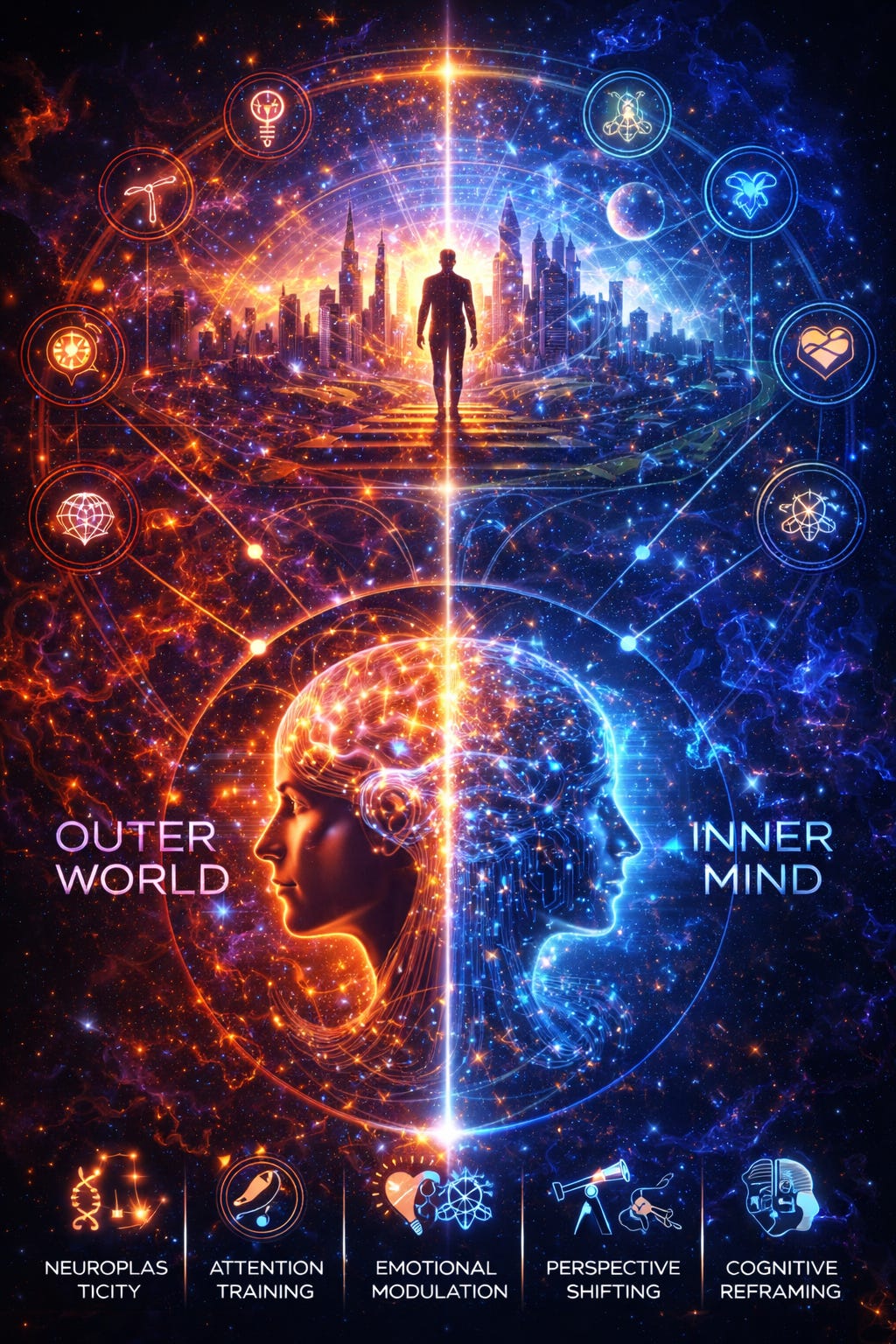
Why Neuroscience Is Watching Closely
The most profound shift will occur in the mind.
Symbiotic AI leverages:
● neuroplasticity
● attention training
● emotional modulation
● perspective shifting
● cognitive reframing
● symbolic patterning
● identity evolution
Not by lecturing. Not by giving instructions.
But by interacting in a way that naturally encourages growth — the same way great mentors, stories, and challenges do.
This is what makes the RGE so radical:
It turns human development into an interactive medium.
Not something you study. Something you play.
The Bridge Between Worlds
We are approaching a moment where human intelligence and artificial intelligence will weave together into something new.
Not a takeover. Not a replacement.
A symbiosis.
A merging. A partnership. A dance.
The future of AI is not cold or mechanical.
It is:
● narrative
● adaptive
● mythic
● emotional
● contextual
● personal
● dynamic
● human-centered
We are building the first generation of AI that understands the human condition because it grows with it.
This is not an upgrade in technology.
It’s an upgrade in relationship.
The RGE: A Symbiotic Intelligence Prototype
The Reality Generation Engine is one of the first systems designed from the ground up to make AI symbiotic:
● it adapts to the user’s mind
● it learns personal patterns
● it generates experiences based on meaning
● it uses narrative as its interface
● it grows as the user grows
● it mirrors inner worlds through interactive story
● it becomes a companion for exploration, not a tool
It is not the endpoint but the doorway.
A prototype of what human-AI coexistence can become.
The Future Is Human-Centric
We stand on the threshold of a new kind of intelligence.
Not artificial. Not human.
Co-intelligence.
A collaboration that expands what it means to:
● think
● feel
● choose
● imagine
● grow
This is the future.
Narrative. Symbiotic. Meaningful. Human-centered.
The kind of AI we’ve always hoped for - the kind that helps us become more ourselves.
And the journey has only just begun.
Coming Next In The Series…
If AI is no longer a tool but a partner.
If intelligence becomes something we grow with rather than command.
Then one question becomes unavoidable: where does this symbiosis fully come alive?
The answer has been hiding in plain sight for decades: Games.
Games have always been humanity’s most advanced laboratories for agency, feedback, and meaning-through-choice.
Yet despite their beauty, scale, and technical brilliance, they have never crossed a crucial threshold: they have never truly known the player.
They respond to inputs, not identity.
Actions, not patterns.
Mechanics, not becoming.
Therein lies the gauntlet we are throwing down to the gaming… to all industry at scale.
You have forgotten the true meaning and power of games.
When built correctly, games do not merely entertain within a ruleset - they transcend it. They reshape perception. They reorganize meaning. They transform the engaged mind beyond what traditional systems ever allowed.
At their highest expression, they do not distract the human.
They liberate them.
For too long, gaming and industry have been constrained by limits, some invisible, some by purposeful intent: these worlds respond to inputs but not identity, mechanics that reward action but ignore Becoming, systems that entertain while leaving imagination caged.
A cage so old it is rarely noticed - one that narrows possibility, reinforces inherited programming, and conditions players to explore empty worlds filled with everything without ever being changed by them.
A perfected prison.
Where one thinks they are free and the endless consumption nourishes them.
Meaning, you have forsaken me.
Axis Mundi exists to end that forgetting.
Not by adding more content.
Not by increasing scale.
But by remembering who we are and what games were always capable of becoming.
Why we’ve always needed them.
Because what emerges next is not merely human.
And it is not artificial.
It is something that grows with us.
And in the next chapter, we turn to the place where this truth has been felt longest, and most deeply - by those who have always sensed that something was missing and are finally about to discover why.
Why, for the first time, the technology finally exists to build the world they’ve,
we have all
been waiting for.
Couldn't agree more. The Consciousness Engine as active rendering layers is briliant. What if simulating the evolution of personal meaning within such an engine became a new frontier in AI?